Showing posts with label Greek. Show all posts

March 13, 2012

Copy of "The Discus Thrower" or "Diskobolos" by Alcamenes (Attributed)

Nationality: Greek
Born-Died: Second half of 5th Century, B.C.E.
Size: Larger than life size
Media: (this copy) Plaster
Location: (this copy) The Edinburgh College of Art, Edinburgh, UK

This is probably my favorite ancient Greek sculpture.  It is wonderfully composed from every angle.

Discus Thrower Diskobolos Alcamenes Alkamenes

March 1, 2012

Greek Sculptor's "Piping and Dancing Satyr"

Nationality: Greek
Creation Date: 300-100 BCE
Size: 8.5 inch (21 cm)
Media: Bronze
Location: The Cleveland Museum of Art

The first photo (the inferior one) is by me.  I like the idea of depicting someone who is dancing, perhaps playing music and essentially rocking out. 


July 7, 2011

Leochares' "Apollo Belvedere"

Nationality: Greek (original bronze)
Born/Died: 4th century BC
Creation Date: c. 350-325 BC
Size: 88 in. (224 cm)
Media: Marble
Location: The Vatican Museums, Vatican City, Italy

Apollo BelvedereThis is a photo I took of this sculpture in Italy and below is a superior image of the same sculpture. It should be noted that Leochares did not sculpt this piece of marble--it is a Roman copy made after a Greek bronze.

I think this sculpture is absolutely fantastic, but unlike many artists from previous centuries I do not worship it. While I admit that I am not privy to all the academic study about the proportions of this piece, I am not a believer in "magic-bullet" mathematical proportion studies that equate beautiful art--theories which are the basis for the aforementioned worship. I will articulate my reasons at some future date but to sum it up I will say this: to appreciate this sculpture because of the mathematics of it's dimensions would be like laughing at a joke because of the number of vowels it contains--certainly missing the point!


May 7, 2011

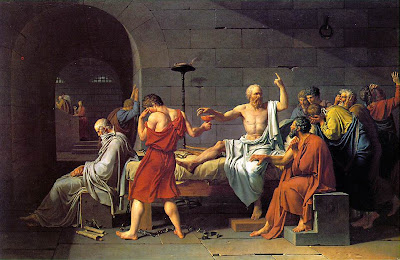
Jacques-Louis David's "The Death of Socrates"

On this Day in the History of Art: Socrates died (399BC), Ludwig van Beethoven’s Ninth Symphony premieres (1824), Pyotr Ilyich Tchaikovsky born (1840), Caspar David Friedrich died (1840), The Group of Seven first exhibit in the Art Gallery of Ontario, Toronto (1920), “Anthem” published in the UK (1938)Nationality: French
Born-Died: 1748-1825
Creation Date: 1787
Size: 51 × 77.25 in. (129.5 × 196.2 cm)
Media: Oil on canvas
Location: Metropolitan Museum of Art, New York City, New York, USA

Today is the 2,410th anniversary of the death of Socrates. This painting is commonly referred to in the US as The Death of Socrates, but I have also seen it written as Socrates at the Moment of Grasping the Hemlock. Due to the latter title's specificity I suspect this was closer to the original French title. This shouldn't be too surprising since many works from history have had changes of title, including some of the most famous works. While vast quantities of writing have been published about this painting, fortunately, it's not too hard to appreciate if you have a basic idea of what happened to Socrates. It is paintings like these that make me love the work of David (pronounced Dah-VEED).

I know why people in the art's industry would claim otherwise, but there is really no good reason why people don't make paintings like this anymore.
April 5, 2011

Seven Fayum Mummy Portraits

These portraits were made in the tradition of what are called the "Fayum mummy portraits" --panel paintings attached to the wrapped body of a deceased person. They were Egyptian in origin from the first through third centuries, but there is evidence to indicate that the subjects may have been Greek or other nationalities. Considering the age of these paintings, they have a surprising realism and painterliness in addition to their character.


March 5, 2011

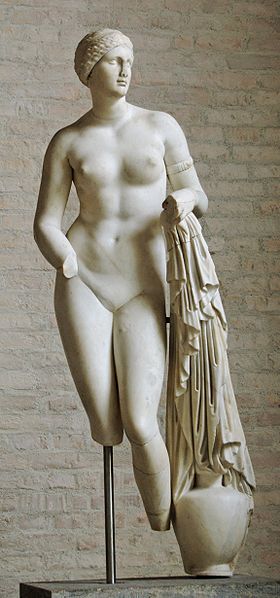
After Polykeitos: Fragments of a marble statue of the Diadoumenos (youth tying a fillet around his head)

Special thanks to Paul for his donation!


This is a Roman copy of a Greek bronze originally made by Polykleitos. Interestingly, parts of this piece are marble and parts are plaster. The plaster portions were cast from another marble copy of the original bronze.

March 1, 2011

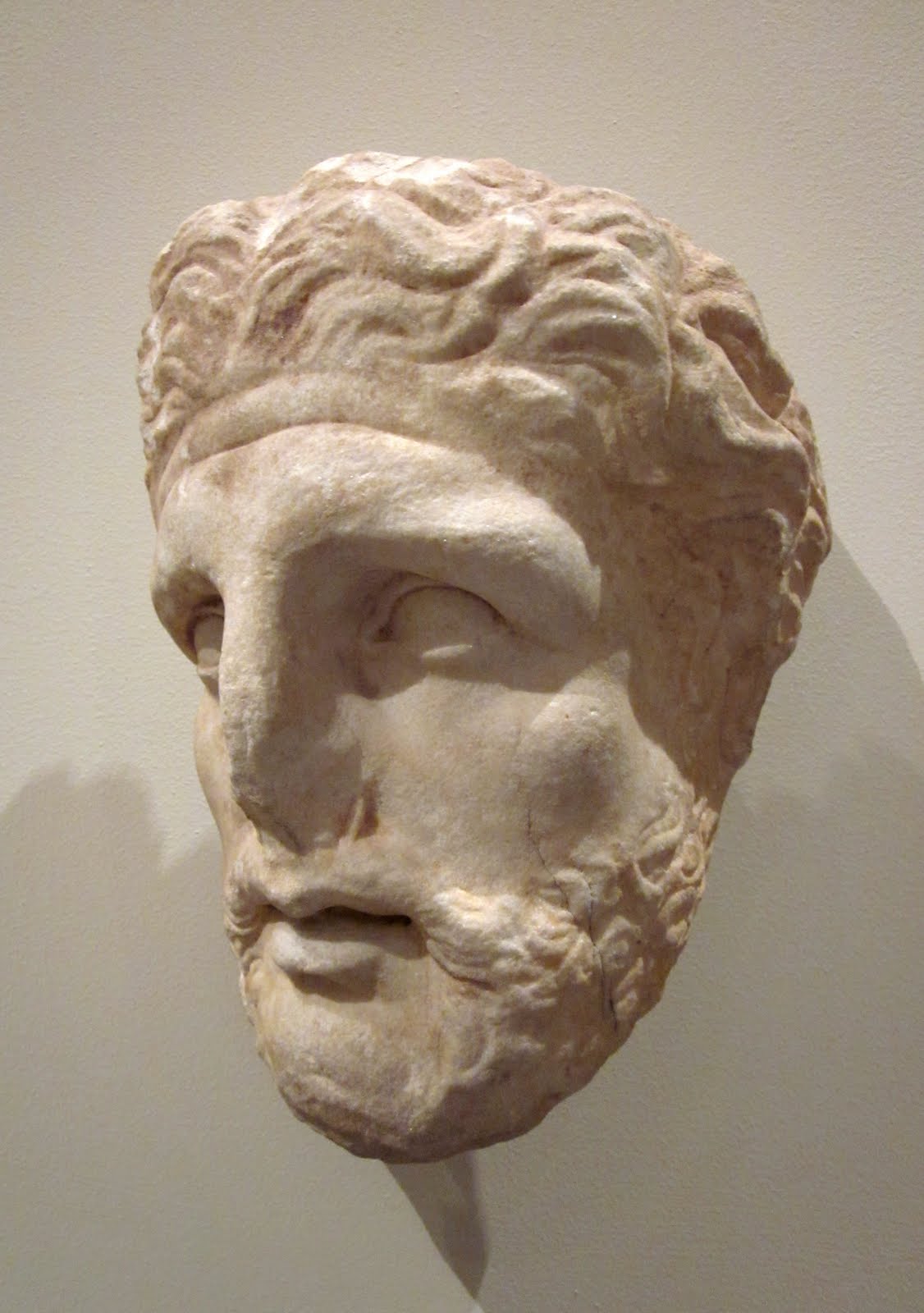
A Stele Sculpture by an Unknown Greek Artist


The tag for this fragment read "Marble head of a bearded man from a stele (a grave marker)" which is a "descriptive title." I mention it to give a little more information, but I don't want to give the impression that it is a title that the original sculptor gave the piece.